Main Article Headline |
Forget Air Fryers And Takeaways An Extraordinary Discovery Near Whittlesey Lets Us Peek Into A Bronze Age Kitchen |
You've had a long day.
You're tired.
Nobody can be bothered to cook.
So you reach for your phone and ask:
“What takeaway do you fancy?”
Now remove the phone.
Remove the takeaway.
Remove the fridge.
Remove Tesco.
Remove electricity.
Remove approximately 3,000 years.
Welcome to dinner.
So What Was Actually On The Menu?
This is where things get fascinating.
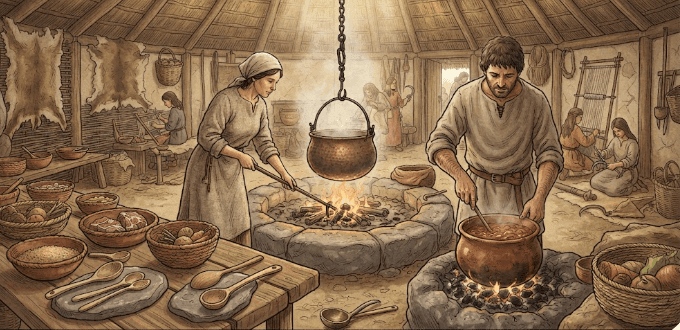
Must Farm, near Whittlesey, has given archaeologists an unusually detailed glimpse into everyday Bronze Age life.
The settlement dates from around 850 BC and was occupied for less than a year before being destroyed by a catastrophic fire.
The conditions helped preserve an extraordinary collection of everyday objects. Museum & Art Gallery
Among the finds associated with life at the settlement are cooking items and fish traps.
Suddenly Bronze Age dinner feels considerably less abstract.
Somebody had to catch it. Somebody had to prepare it. Somebody had to cook it.
And presumably somebody still said:
“I'm not eating that.”
Some things transcend civilisation.
There Was No “Just Pop To The Shop”
This might be the biggest difference.
Today, forgetting an ingredient is annoying.
Three thousand years ago there wasn't a convenient shop five minutes away.
Earlier prehistoric communities in the Peterborough area had already begun growing crops and raising animals, while archaeological evidence shows people making pottery used for serving food and drink.
Food wasn't something you simply bought.
It was tied much more directly to the land, water, animals, seasons and the work required to get it.
Which makes complaining because your supermarket substituted a different brand of baked beans feel slightly less heroic.
And Somebody Still Had To Wash Up
This is the detail history programmes don't spend enough time discussing.
People talk about ancient settlements and say things like:
“Imagine living there.”
Fine.
But imagine the domestic arguments.
Who catches dinner?
Who's cooking?
Who's cleaning the pot?
Whose turn is it to check the fish trap?
And who has left something sitting around the settlement after being asked three times to put it away?
Archaeology gives us objects.
Human nature supplies the rest.
This Is Why Food History Is So Good
Food gives us a way into history that dates and kings often don't.
You can look at a cooking vessel and understand it immediately.
Someone was hungry. Somebody prepared food. People sat together. Something probably got burned. Someone probably wanted more.
These weren't simply Bronze Age people.
They were people having dinner. That's much easier to imagine.
And The Story Isn't Finished
Peterborough Museum is currently working on its My Must Farm project after receiving £250,000 from the National Lottery Heritage Fund.
The work includes digitising the collection and developing a new permanent gallery, with the community helping shape how the discoveries are presented.
So this remarkable local story is going to become easier to explore.
But we're interested in something slightly different.
Your Turn: Could You Do It?
Imagine we've removed every modern food convenience for one week.
No supermarket. No takeaway. No microwave. No fridge. No delivery driver appearing at the door carrying a paper bag containing your happiness.
How long are you lasting?
Put your answer in the comments.
And tell us the one modern food or drink you'd miss first.
Coffee? Chocolate? Pizza? Crisps? Tea? Friday-night curry? We're fairly confident somebody will say:
“I'd be fine.”
That person can check the fish traps in the rain.
Comment below |
0 Comments
Join the conversation
Be the first to comment
Share your thoughts above.